 Tweet
Tweet
 An Interesting Talk About Alignments
A very interesting article about the nature of 3.5 D&D's Alignment system.
http://www.escapistmagazine.com/arti...bout-Alignment
The article is re-printed below to facilitate easy reading:
------------------------------------------------
Ah, alignment. Has any rule in Dungeons & Dragons caused more arguments? Ever since Gary Gygax first decided to make paladins the most powerful fighters in the game provided they followed a strict alignment code, the problems of alignment have bedeviled players and gamemasters alike. In this column, we're going to tackle the thorny issue of alignment and try to make sense of it all.
There Really Is an Axis of Evil
For those of you unfamiliar with the D&D alignment system, it divides moral behavior into two axes: The Lawful/Neutral/Chaotic axis and the Good/Neutral/Evil axis. A character's alignment is composed of one element from each axis, creating combinations such as "Lawful Good" and "Neutral Evil". According to the d20 rules, these encompass "a broad range of personal philosophies" that are "a tool for developing your character's identity." The dual axis system remains widely popular, with a whole line of t-shirts and homages in everything from Warhammer to Fable II's dual morality and purity axes.
That sounds well and good; yet most gamers, having not studied moral philosophy, simply lack the vocabulary to assess what good or evil means, let alone law or chaos. Even the simplest assessments often lead to long arguments: If a Lawful Good hero tells a lie in order to save someone's life, has he violated his alignment? If Luke Skywalker really did restore order to the galaxy along with Darth, would that have been Evil? Is Highlander's Kurgan being Chaotic when he madly drives down the wrong side of the road in New York City, or is he just being an idiot? Confusion is nowadays so great that TV Tropes has pages documenting and ridiculing the problems of Lawful Anal and Chaotic Stupid characters. To avoid the Stupid, some modern gamers eschew alignment altogether, consigning it to the trash bin of game design.
Despite the problems of alignment, throwing out alignment is the wrong move for most campaigns. The classic struggle of good versus evil appears repeatedly in myth, legend, and fiction. To ignore alignment is to ignore the most powerful themes that underlie gaming's popular genres. The Lord of the Rings is hardly a gripping story if the Reign of Sauron and Aragorn are morally equivalent. Even the most deconstructionist of epic fantasy works - George R. R. Martin's Game of Thrones - still offers us examples of true D&D-style Chaotic Evil.
With morality hardcoded into the genres they emulate, Dungeons & Dragon's alignment system is worthy of use in play. So can sense be made of it? The answer is yes! The past 3,000 years of moral theory may not have led us to world peace, but Aristotle, Bentham, Kant, and Nietzsche have at least provided us some answers to our D&D dilemmas.
Let's start with the basics: A moral code is a system of values that differentiates between good and bad, right and wrong. Over the past three thousand years, moral philosophers have developed a staggering amount of moral codes based on differing assessment of the objectivity, perspective, scope, and substance of moral codes. Of the vast range of possible moral questions one can ask, however, solving our alignment dilemma really only asks us to answer two questions: How do you judge the "goodness" of an action? And who are the proper beneficiaries of "good" behavior, i.e. whose "good" are we talking about? The answer to the first question will establish a person's place on the spectrum of Law and Chaos; the answer to the second question, their place on the spectrum of Good and Evil.
It's All Clear Once You Realize Lawful Just Means Deontological
So our first question is "how you judge the 'goodness' of an action?" Moral philosophy offers us three main answers: By the action itself (deontological); by the consequences of the action (consequentialist); and by the character of the action (aretological). These three map nicely to Lawful, Chaotic, and Neutral, as will be shown below.
Deontological, or rules-based, ethics judge the goodness of an action based on whether the action itself adhered to a set of principles developed in advance. Most religions include deontological ethical systems: When the Ten Commandments say "you shall not steal," it means that you shall not steal, period. It doesn't matter if your family is starving and you need the bread; stealing is wrong because the Commandment says so. Some secular systems are also deontological. During the Enlightenment, Immanuel Kant developed his incredibly influential deontological system based on Categorical Imperatives, or maxims for rightful action. Murray Rothbard's non-aggression principle is a famous libertarian deontological system. As a result of their philosophy, deontologists generally believe that rules should be obeyed; promises should be kept; processes should be followed; and that ends never justify means. They are, in short, Lawful!
In contrast to the strict principles of deontological ethics, Chaotic characters believe in consequentialist or act-based ethics: They judge the goodness of an action based on the consequences of the action. To a consequentialist, rightness or wrongness is judged by the result of the deed, not the deed itself. Jeremy Bentham's act-based utilitarianism, which instructs its adherents to act to produce the greatest good for the greatest number, is the most famous consequentialist moral system. Consequentialists are results-oriented. They believe that promises can be broken, rules ignored, and laws overridden, because the end always justify the means. They are the essence of Chaotic, prone to answering claims that they've broken a contract by saying "I am altering the deal - pray I don't alter it any further."
In between these two positions is a third way, which could be called aretological, or character-based ethics. To an aretologist, the goodness of an action is judged based on the character trait which motivated the action. While they ultimately judge the rightness or wrongness of deeds in their totality by their consequences, they believe that it is impossible to predict what the consequences are likely to be in most circumstances. Instead, we should generally behaving in accordance with particular character traits (the "virtues") which tend to promote these desirable consequences overall. John Stuart Mill's rules-based utilitarianism and Aristotle's virtue ethics both lead to similar reasoning, leading to moral "rules of thumb" or "habits" which should be followed unless there is a strong reason for not doing so. Such people will generally follow the rules and keep their promises, but not so strictly as Lawful characters, but may act on a case-by-case basis when circumstances dictate, though not with such disdain for custom and law as Chaotics. They are, in short, Neutrals. When you ponder whether it's permissible to drive through the stop light when there's nobody around, you're thinking like a Neutral. (The Lawful person would never consider it, and the Chaotic person drove through as soon as he knew it was safe.)
(Continued on next post)
http://www.escapistmagazine.com/arti...bout-Alignment
The article is re-printed below to facilitate easy reading:
------------------------------------------------
Ah, alignment. Has any rule in Dungeons & Dragons caused more arguments? Ever since Gary Gygax first decided to make paladins the most powerful fighters in the game provided they followed a strict alignment code, the problems of alignment have bedeviled players and gamemasters alike. In this column, we're going to tackle the thorny issue of alignment and try to make sense of it all.
There Really Is an Axis of Evil
For those of you unfamiliar with the D&D alignment system, it divides moral behavior into two axes: The Lawful/Neutral/Chaotic axis and the Good/Neutral/Evil axis. A character's alignment is composed of one element from each axis, creating combinations such as "Lawful Good" and "Neutral Evil". According to the d20 rules, these encompass "a broad range of personal philosophies" that are "a tool for developing your character's identity." The dual axis system remains widely popular, with a whole line of t-shirts and homages in everything from Warhammer to Fable II's dual morality and purity axes.
That sounds well and good; yet most gamers, having not studied moral philosophy, simply lack the vocabulary to assess what good or evil means, let alone law or chaos. Even the simplest assessments often lead to long arguments: If a Lawful Good hero tells a lie in order to save someone's life, has he violated his alignment? If Luke Skywalker really did restore order to the galaxy along with Darth, would that have been Evil? Is Highlander's Kurgan being Chaotic when he madly drives down the wrong side of the road in New York City, or is he just being an idiot? Confusion is nowadays so great that TV Tropes has pages documenting and ridiculing the problems of Lawful Anal and Chaotic Stupid characters. To avoid the Stupid, some modern gamers eschew alignment altogether, consigning it to the trash bin of game design.
Despite the problems of alignment, throwing out alignment is the wrong move for most campaigns. The classic struggle of good versus evil appears repeatedly in myth, legend, and fiction. To ignore alignment is to ignore the most powerful themes that underlie gaming's popular genres. The Lord of the Rings is hardly a gripping story if the Reign of Sauron and Aragorn are morally equivalent. Even the most deconstructionist of epic fantasy works - George R. R. Martin's Game of Thrones - still offers us examples of true D&D-style Chaotic Evil.
With morality hardcoded into the genres they emulate, Dungeons & Dragon's alignment system is worthy of use in play. So can sense be made of it? The answer is yes! The past 3,000 years of moral theory may not have led us to world peace, but Aristotle, Bentham, Kant, and Nietzsche have at least provided us some answers to our D&D dilemmas.
Let's start with the basics: A moral code is a system of values that differentiates between good and bad, right and wrong. Over the past three thousand years, moral philosophers have developed a staggering amount of moral codes based on differing assessment of the objectivity, perspective, scope, and substance of moral codes. Of the vast range of possible moral questions one can ask, however, solving our alignment dilemma really only asks us to answer two questions: How do you judge the "goodness" of an action? And who are the proper beneficiaries of "good" behavior, i.e. whose "good" are we talking about? The answer to the first question will establish a person's place on the spectrum of Law and Chaos; the answer to the second question, their place on the spectrum of Good and Evil.
It's All Clear Once You Realize Lawful Just Means Deontological
So our first question is "how you judge the 'goodness' of an action?" Moral philosophy offers us three main answers: By the action itself (deontological); by the consequences of the action (consequentialist); and by the character of the action (aretological). These three map nicely to Lawful, Chaotic, and Neutral, as will be shown below.
Deontological, or rules-based, ethics judge the goodness of an action based on whether the action itself adhered to a set of principles developed in advance. Most religions include deontological ethical systems: When the Ten Commandments say "you shall not steal," it means that you shall not steal, period. It doesn't matter if your family is starving and you need the bread; stealing is wrong because the Commandment says so. Some secular systems are also deontological. During the Enlightenment, Immanuel Kant developed his incredibly influential deontological system based on Categorical Imperatives, or maxims for rightful action. Murray Rothbard's non-aggression principle is a famous libertarian deontological system. As a result of their philosophy, deontologists generally believe that rules should be obeyed; promises should be kept; processes should be followed; and that ends never justify means. They are, in short, Lawful!
In contrast to the strict principles of deontological ethics, Chaotic characters believe in consequentialist or act-based ethics: They judge the goodness of an action based on the consequences of the action. To a consequentialist, rightness or wrongness is judged by the result of the deed, not the deed itself. Jeremy Bentham's act-based utilitarianism, which instructs its adherents to act to produce the greatest good for the greatest number, is the most famous consequentialist moral system. Consequentialists are results-oriented. They believe that promises can be broken, rules ignored, and laws overridden, because the end always justify the means. They are the essence of Chaotic, prone to answering claims that they've broken a contract by saying "I am altering the deal - pray I don't alter it any further."
In between these two positions is a third way, which could be called aretological, or character-based ethics. To an aretologist, the goodness of an action is judged based on the character trait which motivated the action. While they ultimately judge the rightness or wrongness of deeds in their totality by their consequences, they believe that it is impossible to predict what the consequences are likely to be in most circumstances. Instead, we should generally behaving in accordance with particular character traits (the "virtues") which tend to promote these desirable consequences overall. John Stuart Mill's rules-based utilitarianism and Aristotle's virtue ethics both lead to similar reasoning, leading to moral "rules of thumb" or "habits" which should be followed unless there is a strong reason for not doing so. Such people will generally follow the rules and keep their promises, but not so strictly as Lawful characters, but may act on a case-by-case basis when circumstances dictate, though not with such disdain for custom and law as Chaotics. They are, in short, Neutrals. When you ponder whether it's permissible to drive through the stop light when there's nobody around, you're thinking like a Neutral. (The Lawful person would never consider it, and the Chaotic person drove through as soon as he knew it was safe.)
(Continued on next post)


 ) He will only have a small circle of close friends, if any at all, and while he means to do good by the ethical standards of his patron deity, he will actually be stepping on most peoples' toes along the way. Someone who is good really doesn't need to help everyone at all, at least not what those same people would consider to be helpful, because that is very conflicting. Helping a slave escape is not helpful to the master, but it's still a good action (where how exactly it's done might indicate some place on the law-chaos axis). He'll be breaking the laws of society, yet he's still going to be Lawful Good. Granted, he probably isn't going to live long if he sticks to his standards.
 ). He'd apply his morals on a case by case basis in the interests of single individuals and acts rather rashly and on gut feeling and dramatic sense. This character would be Chaotic Good in my eyes, but according to the article, he would be acting Chaotic Evil much of the time.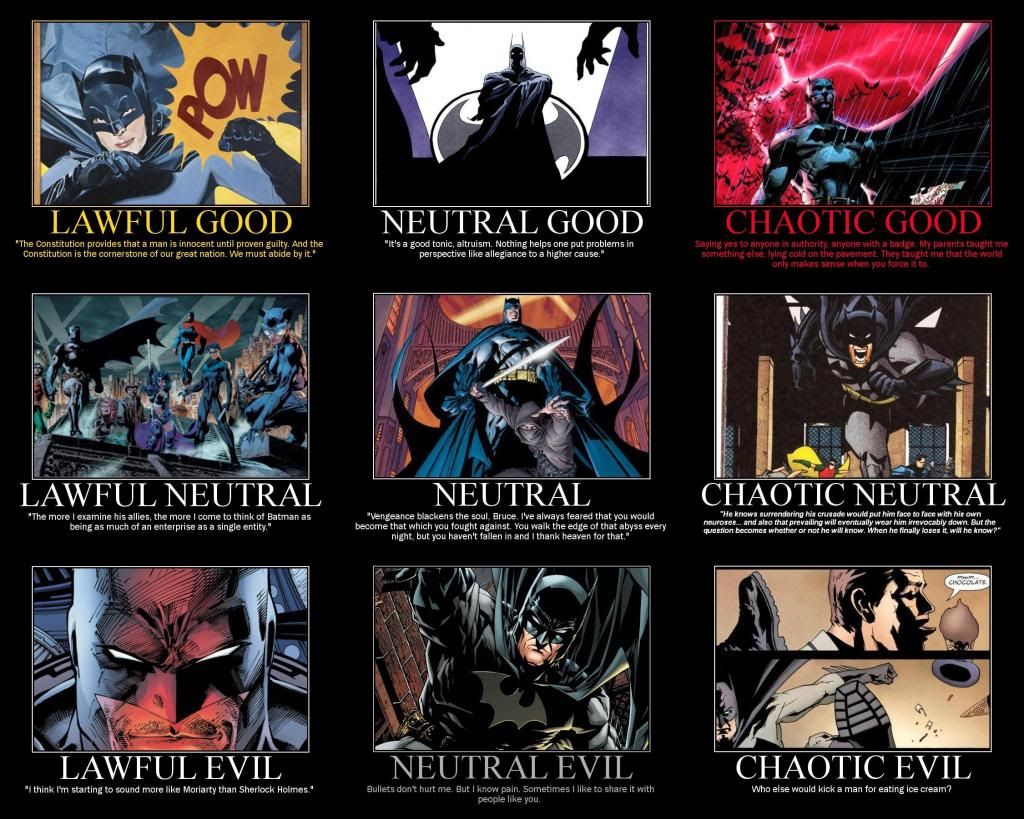

Comment